Connect Clio Manage
A step-by-step guide with pictures, from the Speakvora agent's own Connect tab.
Short answer: This connects your own Clio account to your Speakvora agent. Then a customer can text where is order 1234 and get the answer in seconds, and the agent can send status and tracking texts. The agent only reads. It can never create, change or delete anything in Clio. Only the status word and the order number are ever.
Every key, number and name in the pictures is a made-up example. Nothing here asks you to share a real key with anyone but the app on your own computer.
This connects your own Clio account to your Speakvora agent. Then a customer can text *where is order 1234* and get the answer in seconds, and the agent can send status and tracking texts. The agent only reads. It can never create, change or delete anything in Clio. Only the status word and the order number are ever texted back, never names, prices, items or addresses.
TIP: You need about 15 minutes, a computer, and the sign-in for your Clio account (the owner or a manager). You can't break anything: if a step does not work, nothing has changed and you can just try again. The keys and screens below are made-up examples.
NOTE: This guide was written from Clio's public developer documentation (the addresses and sign-in style were read there) and has not been tried yet on a live Clio account. If a screen looks different from what is described, press Connect, then Download report, and send it to support. We fix it for everyone.
Who this is for: legal services. How Clio gives access: The vendor connects through an authorised app. Follow the steps below to create or authorise it in your own account. What it costs you: Creating a Clio developer application is free; you need your own Clio Manage account. Plan cost not stated in the developer docs.
Part 1. Get your key from Clio
Do this on your computer, in a new browser tab, signed in to Clio.
- Sign in to the Clio Developer Portal with your Clio Manage login (use the account for your region).
- Open Applications and press Add Application (or Create).
- Enter a Name such as Speakvora, your Website URL and a Redirect URI, and accept the Developer Terms of Service.
- Under App Permissions choose read-only access for Matters and Users only.
- Save, then copy the App Key and App Secret shown for the application.
- Run the OAuth authorization code flow once (open the authorize link, log in, press Allow) to get an access token.
- Paste the access token into Speakvora and press Test; it calls who_am_i.
- Matter lookups read one matter by its id and return open, pending or closed.
WARNING: If Clio asks which permissions to give, tick only the read-only ones: Matters: read, Users: read (who_am_i). Never give write or admin access.
TIP: To copy the key, click inside the box that shows it, press Command + C on a Mac or Ctrl + C on Windows (or right-click and choose Copy). Nothing will look different. It is now in your clipboard, ready to paste. Keep it private: anyone who has it can read your orders.
Part 2. Open the Connect tab in your agent
- Open your agent's dashboard (the page you open from the Start Speakvora Agent file).
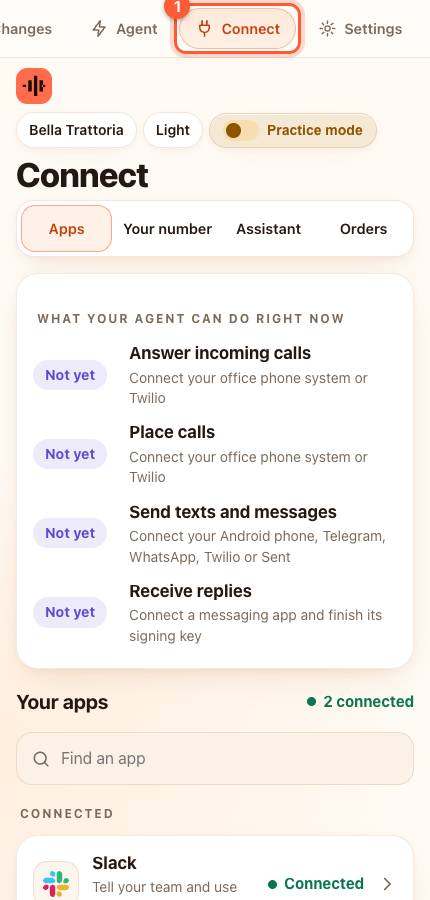
- Press Connect in the menu. On a phone the menu is the bar along the top; slide it sideways if you do not see Connect.
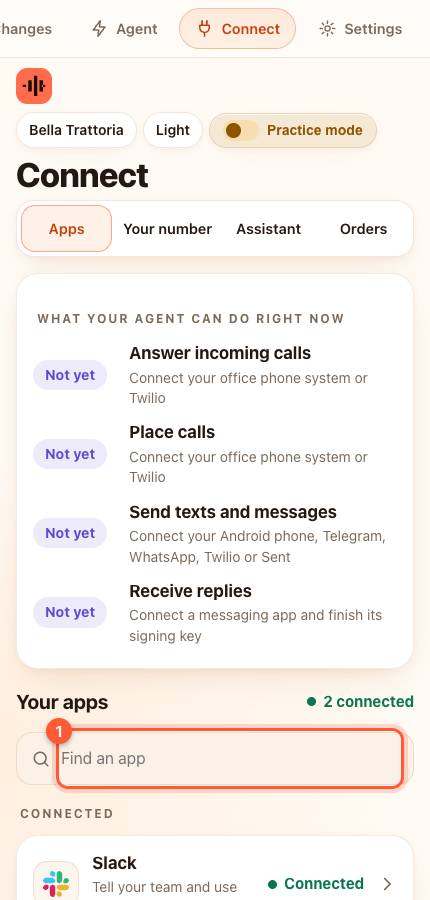
- Under Your apps type Clio in the box that says Find an app (1), or scroll down the list.
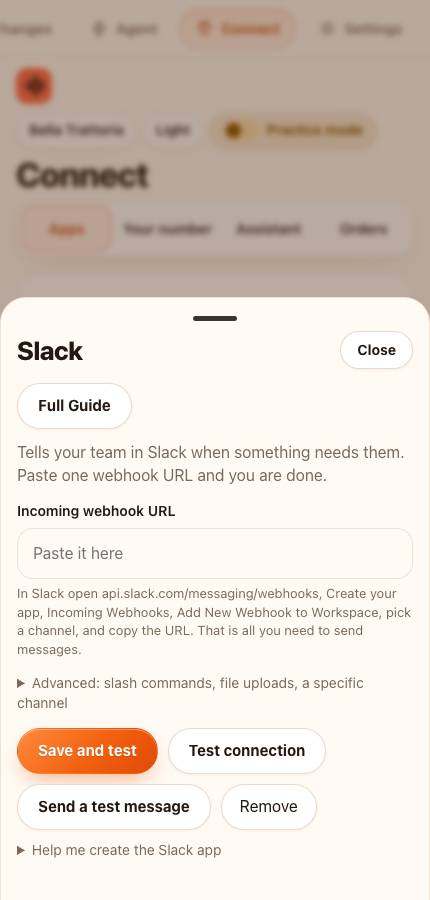
- Press Clio Manage. A card slides up. (If you only see apps for your own kind of business, that is on purpose: your agent only shows the systems that make sense for it.)
Part 3. Paste it in
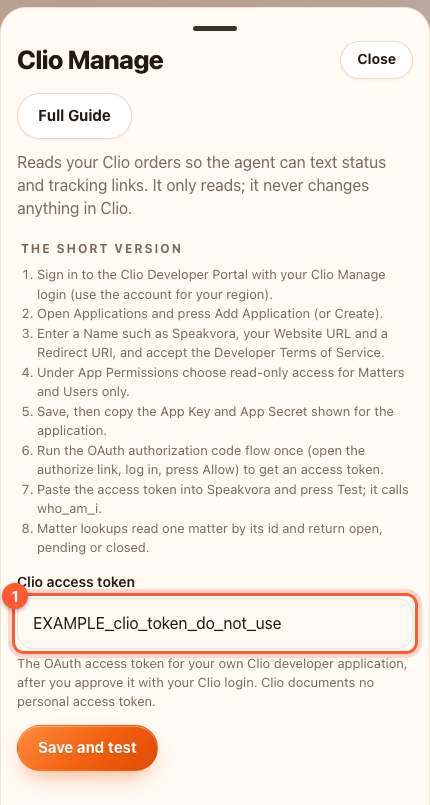
1 box to fill in. Click inside a box, press Command + V on a Mac or Ctrl + V on Windows, then move to the next:
- Clio access token (secret: it stays on this computer and is never shown again, only the last few characters). The OAuth access token for your own Clio developer application, after you approve it with your Clio login. Clio documents no personal access token.
TIP: Pasted by mistake into the wrong box? Click the box, press Command + A (Ctrl + A on Windows) to select all, then paste again.
Part 4. Test it
- Press the orange Save and test button.
- Clio is asked for one harmless record, just to prove the key works. Nothing is changed in Clio.
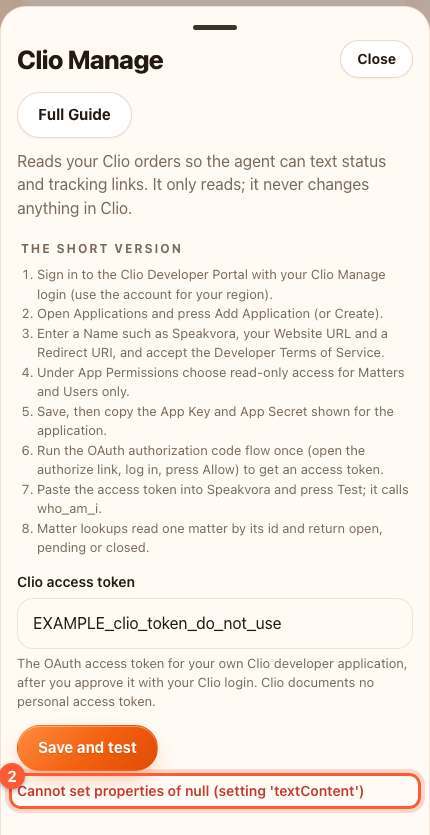
YOU SHOULD SEE: green words starting with Connected.
WARNING: Red words mean it did not work yet. Read them, then see If something is wrong below. Nothing bad happened.
What happens next
- A customer texts something like where is order 1234. The agent answers *Your order 1234 is preparing.* (the status word from Clio), or *I could not find that order. A team member will check and reply.*
- Each person can ask five times an hour. If Clio is down, the conversation carries on and the problem is written to Activity.
- Mode: the agent asks Clio when a customer asks.
If something is wrong
- It says the key was refused (401 or 403): copy the key again from Clio. Make sure there is no space before or after it, and that it is a live key for the right shop or location.
- It cannot find an order (404): the number is not in Clio, or Clio uses a longer number than the one on the receipt.
- It says too many requests (429): wait a minute and press Save and test again.
- Clio says you need a plan or approval: Clio Manage only offers OAuth 2.0. There is no personal access token, so the token must be obtained through the authorization flow of your own developer application, and it expires (about 30 days) unless refreshed with the refresh token. This spec uses the US host app.clio.com; other regions need their own app and host (for example the EU app), which was not confirmed. Matter status is only open, pending or closed. Trust accounting data is not read.
- Still stuck? Press Connect, then Download report, and email it to support. It never contains keys or customer messages.
If your plan has no API
- Ask the firm to export the matter list from Clio Manage as a report.
Clio's own instructions: https://docs.developers.clio.com/api-docs/clio-manage/applications/
All help guides · Every agent feature · AI receptionist by industry
Questions
What if this happens: It says the key was refused (401 or 403)?
copy the key again from Clio. Make sure there is no space before or after it, and that it is a live key for the right shop or location.
What if this happens: It cannot find an order (404)?
the number is not in Clio, or Clio uses a longer number than the one on the receipt.
What if this happens: It says too many requests (429)?
wait a minute and press Save and test again.
What if this happens: Clio says you need a plan or approval?
Clio Manage only offers OAuth 2.0. There is no personal access token, so the token must be obtained through the authorization flow of your own developer application, and it expires (about 30 days) unless refreshed with the refresh token. This spec uses the US host app.clio.com; other regions need their own app and host (for example the EU app), which was not confirmed. Matter status is only open, pending or closed. Trust accounting data is not read.
What if this happens: Still stuck??
Press Connect, then Download report, and email it to support. It never contains keys or customer messages.